garnaut report
9 Sep 2008
Goodbye, Murray Darling
Garnaut's latest report makes for depressing reading, writes Ben Eltham. It now looks as though Australia will not move to significantly reduce its greenhouse gas emissions
The latest installment in Professor Ross Garnaut's tortuous journey through the travails of climate change policy was released on Friday. Entitled Targets and Trajectories, it is officially a supplementary addendum to his substantial Draft Report published in June, which we analysed at newmatilda.com here.Garnaut's latest report is another politically calibrated and media-savvy document that contains a number of surprises in the fine detail. It's clear that Professor Garnaut has a substantial command of the bedevilling policy detail of climate change. Sadly, it looks as though the immense amount of detailed knowledge he has acquired in the past year has made him pessimistic for the fate of the planet.
What does the report say? Basically, it contains Garnaut's first approximations of how much and how quickly Australia should cut its greenhouse gas emissions.
Garnaut's headline figures are low, especially for his 2020 target. He argues Australia should aim for a 10 per cent cut in emissions compared to 2000 levels by 2020, and an 80 per cent cut by 2050. This target should be made in the context of a global agreement to stabilise global atmospheric carbon dioxide levels at around 550 parts per million (they are about 384ppm now). We should really be aiming for 450 or 400, Garnaut writes, but he thinks there is very little chance the world will be able to agree to such significant reductions.
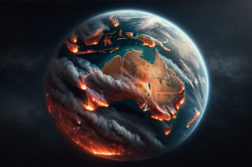
newmatilda.com readers will recall, as prominent climate scientist James Hansen has argued, that the true threshold for significant, long-term, irreversible climate change is actually even lower than this: probably 320 parts per million. So even Garnaut's best case target still leaves Australia in a dramatically hotter, drier, more fire-, drought- and cyclone-prone future. That's the best case.
The worst case? It's difficult to imagine, but we should try, just for a minute. The business-as-usual scenario is a hell on earth. Garnaut quotes a paper by respected (and quite conservative) global security and war think-tank, the Centre for Strategic and International Studies, which concluded "The collapse and chaos associated with extreme climate change futures would destabilise virtually every aspect of modern life."
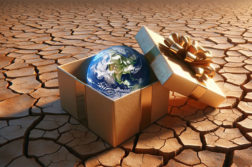
You can stop worrying about the Great Barrier Reef and the Murray Darling in that scenario. They'll be long gone, and we will instead be worrying about Greenland and much of Antarctica melting away. At that point, coastal Australians would be well advised to invest in some life jackets and flippers.
Garnaut seems to be getting more and more depressed about the prospects of global action on this most important of international policies. "There are moments in the history of humanity when fateful choices are made," he writes, and "the decision over the next few years on whether to take strong action to mitigate human-induced climate change is one such moment." Garnaut goes on to argue that the potential economic and social dislocation of business as usual - resulting in a 5.6 degree increase in global temperatures - would be comparable to the impact of the Great Depression, or perhaps even worse. Garnaut gives the world "just a chance" of avoiding this fate. "The process of international cooperation," he writes, "... is perhaps the most formidable of international relations challenges; more formidable than the multilateral trade negotiations which have recently collapsed."
Garnaut then goes on to say that if the world cannot come to a post-Kyoto agreement on emissions reductions, Australia should aim for a cut of only 5 per cent on 1990 levels by 2020, which would basically equal a $20 per tonne carbon price plus CPI. It should be remembered, of course, that the business-as-usual scenario would see substantial increases in Australia's greenhouse gas emissions, so even a 5 per cent cut is actually a reasonably significant decrease on how much we would have emitted. It's just that it won't be enough. Not nearly enough.
Small wonder then, that this depressingly low target has attracted considerable criticism from the greener end of the spectrum, particularly the lobby groups like The Climate Institute, and three scientists from the UN's climate change panel. Climate Institute CEO John Connor attacked the targets, saying Penny Wong should reject them. "Accepting the recommended 2020 targets of 5 or 10 per cent reductions," he stated, "would strip Australia of international credibility in global climate talks." Climate activists Anna Rose and Amanda McKenzie make the excellent point that "failing to aim for where we want to go will guarantee that we will not get there", while Kenneth Davidson observes that, given what we know of the science, "the 450-550 ppm range is not so much a target but a signpost to disaster".
But big business seems quite pleased, according to their cheerleaders at The Australian. This also is not surprising, given that Garnaut has proposed something much closer to their preferred policy option of doing as little as possible.
It's hard not to conclude that cynicism about the so-called "political reality" of climate policy has got the better of Professor Garnaut. That's a tragedy, because that very reality has been shaped not just by runaway growth in the developing world but by the baleful influence of special interests, such as the Business Council of Australia, in the developed.
Accepting this reality now means saying goodbye to our present global climate conditions ... forever.


Delicious
Digg
StumbleUpon
Reddit
Newsvine
Facebook
Kwoff


Discuss this article
To participate in the discussion Sign in or Register
UPDATE: The Sydney Morning Herald has tracked down some comment from 3 leading Australian climate scientists who are members of the IPCC.
"Speaking separately, Bill Hare, David Karoly and Amanda Lynch - all authors with the Nobel Peace Prize-winning Intergovernmental Panel on Climate Change - criticised Professor Garnaut’s recommendations, describing them as inconsistent, disappointing and wrong."
http://www.smh.com.au/news/global-warming/garnaut-is-wrong-say-scientist…
It is hard to imagine how people will adjust to the frightening changes coming our way. How bad will it need to get before there is genuine and irreversible social breakdown? How many days without water can a city go? How many weeks without fresh food?
The problem for me now is to know when to start buying canned goods and building a bunker in a well watered rural spot. I suspect like everyone else I won’t know I need to take action until it is too late.
Or is it just going to be a steady erosion of quality of life, rights and living standards, until we find ourselves living some sort of post apocolyptic ‘Blade Runner’ exsistence, wondering where it all went wrong?
Initially my thoughts about Professor Garnaut’s ‘U’ turn made me wonder who had got to him. On sober reflection I am wondering if the sheer size of the problem has no possible solution. It should never have been called climate change, or global warming. Both ambivalent and hazy tags. Tags which gave people like Andrew Bolt an easy target to hurl his deliberate half-lies at. Of course, the people who read the Melbourne Chunder Box Daily don’t have the wit to question his facts, or more likely they they don’t have the energy to tackle such a ravening nutter.There have always been variations in the world’s climate. So Bolt uses this as a wonderful bit of ambiguity about the terminology. It should always have been called the ‘population explosion’: it is difficult to argue about a figure of 6 billion people (of course, the more people, the more they will cause the climate to change): also, it is sheer mathematics to work out how long it will take for the 6 billion to become 26 billion. It’s almost as if, somewhere along the line, the Catholic Church caught wind of the then, coming debate about the insane population explosion and thought it would be smart thinking to preempt the discussion. By replacing it with a less threatening, arguable, somewhat fuzzy bit of nomenclature. And boy did it work. It is just so obvious that I’m surprised no one else has thought about it.
Mankind is doomed to *uck himself into extinction; it’s just that all forms of religion have hastened the process. It is no wonder Ross Garnaut has lost a little of his enthusiasm.
Dr Dog: Try turning the title ‘global warming’ into ‘population explosion’, read my commet, and you will know exactly where it all went wrong.
Cheers
Venise
I think Garnaut’s view is that no matter what the developed world does, the chances of the developing world, in the next batch of negotiations, agreeing to the kind of cuts necessary for a 450ppm world are very small.
Robert Merkel.
A couple of things I’m confused about:
1) I’m baffled as to why, if Garnaut recognises that climate change is such a serious problem, he’s advocating that we cut emissions by so little. I get that it’s because Australia acting alone won’t change anything, but it strikes me as very nihilistic.
2) I think it’s important to note that Garnaut suggests we make the 5% cuts only if a satisfactory post-Kyoto agreement isn’t reached. Ben, what do you think the likelihood of this happening is?
Hi Robert, I agree with you that this is a good characterisation of Garnaut’s views.
However I also think that progress towards a contraction and convergence scenario will be so much harder if the industrialised nations are not prepared to lead on the issue.
It’s also worth remembering, as Jeffrey Sachs notes in his latest book, that China is taking more action at an earlier stage of its industrliasation trajecory than any other rich nation so far.
In contrast, Australia committed to coal-fired power stations comparatively late in the day: Australia’s very high carbon-intensity is actually a result of decisions taken once the broad outlines of the greenhouse problem were already known.
Hi enirahccas
Robert has answerd 1) so I’ll answer 2)
Basically the chances are not good, especially if the current appraoch by the rich-world (including and especially Australia) to multi-lateral negotiations continues.
Recall that the Doha round of trade talks collapsed essentially because rich nations wer simply not prepared to offer enough concessions to developing countries - despite the fact that the Doha round was inf act always meant to be about development goals. It was even called the "development" round. This is the nub of the "prisoner’s dilemma" that Garnaut talks about.
Rich nations have consistently found it very hard to put aside their self-interest in inter-state negotiations. For instance, Australia played an extraordinarily strong negotiating nad against tiny, nascent East Timor in negotiating oil and gas rights in the Timor Sea, even when a more sensible reading of Australia’s self-interest would suggest an independent and sustainable Timor Leste would be in Australia’s best interests.
Australia’s negotiating position at the original Kyoto conference is another example. It is not well rememberd but Australia nearly derailed the entire treaty (!) by holding out to the final moments of the negotiaitons for a Kyoto target that included both an increase in emissions and the counting of land-clearing (labelled "the Australian clause").
Narrow definitions of self-interest have characterised much of the rich world’s approach to these kind of issues.
I bet Garnaut’s got a bunker. I bet he has canned food and bottled water coming out his wazoo. He knows where things are headed.
Does anyone really suggest that we will drag the world kicking and screaming into an effective response to climate change? I think it much more likely that the majority will cling to their possessions even as the tide rises and rains cease, then cry out for a saviour.
If overpopulation is your problem Venise, then sit back and wait. I predict a lot less people in the next 100 years, either by choice or by lack of water and food, depending what comes first.
Professor Garnaut admits to the acute seriousness of global warming but his prescription of ”10% off 2000 Domestic CO2 pollution by 2020” in actuality means a 52% INCREASE in Australia’s total Domestic plus Exported fossil fuel-derived CO2 pollution and is a recipe for global and Australian disaster.
In brief, the official US Energy Information Administration (see: http://www.eia.doe.gov/ ) provides detailed data for over the last decade of Australian fossil fuel-derived Domestic, Exported and Total CO2 pollution that, for example, were 352, 348 and 700 millions of tonnes CO2 (Mt CO2) in 2000.
If you plot this data versus time you obtain 3 beautiful straight lines that on extrapolation yield values of Australian Domestic, Exported and Total CO2 pollution of 540, 750 and 1,290 Mt CO2 in 2020.
However Professor Garnaut’s recommendation of essentially “10% off 2000 Domestic CO2 pollution by 2020” in actual reality means Domestic, Exported and Total CO2 pollution of 317, 750 and 1,067 Mt CO2 .in 2020 - an INCREASE by 2020 of 52% on the 2000 value of Total Australian fossil fuel-derived CO2 pollution (for carefully documented details simply NOT discussed in "Look the other way" Australia see: http://sites.google.com/site/yarravalleyclimateactiongroup/what-top-aust… ).
Taxpayer-funded Professor Garnaut should explain to Australia why he has ignored Australia’s huge Exported CO2 pollution; ignored land use, waste and agricultural sources of greenhouse gases; and ignored the immense cost of the estimated 5,000 Australians who die each year from the effects of pollutants from coal burning-based power generation.
For carefully documented details of these failures in the Garnaut Review, final Garnaut Recommendation, and the Federal Government Green Paper see the Climate Emergency Fact Sheets of the Yarra Valley Climate Action Group: http://sites.google.com/site/yarravalleyclimateactiongroup/Home .
3 of Australia’s top climate scientists who are all on the the Nobel Prize winning IPCC, namely Professor David Karoly, Dr Bill Hare and Professor Amanda Lynch have roundly condemned the gross insufficiency of Garnaut’s prescription of "10% off by 2020"( see “The Age”: http://www.theage.com.au/national/garnaut-is-wrong-say-scientists-200809… ).
The Garnaut-Rudd-Wong "all talk, do nothing" approach will destroy the Murray -Darling and the Great Barrier Reef on their own admission (their lowest target is 450 ppm CO2 at which level the world’s coral reefs start dying; their middle estimate of 500 ppm is when the ocean phytoplankton and the Greenland Ice shelf goes).
Professor Amanda Lynch said of the Garnaut Recommendation: ""I think they will take it as another piece of evidence that Australia is not really interested in walking the walk …How much is it worth to us to have a Great Barrier Reef? How much is it worth to us to be self-sufficient in food? These are the sort of things where setting a value on it are quite challenging, and he largely skirted those issues."
Love of Australia means:
1. love of fellow Australians (63,000 of whom currently depend on the Great Barrier Reef for full time employment according to access Economics but will lose their livelihoods under the Garnaut Scenario) ;
2. it means love of Australia’s flora and fauna (yet this disastrous prescription will assuredly kill the Great Barrier Reef and other ecosystems ( see the condemnation of the Garnaut Scenario by top Australian scientists in “The Age”: http://www.theage.com.au/national/garnaut-is-wrong-say-scientists-200809… ).
3. it means love of Australian values (most notably being "fair dinkum"; ignoring by Garnaut and the Rudd Government of huge realities such as the estimated 5,000 annual Australian deaths from coal burning pollutants is totally unacceptable).
Aussies who genuinely love their country can no longer vote for the ecocidal Nelson-Rudd Lib-Labs.
Peace is the only way but Silence kills and Silence is complicity.
ben.eltham of the 3 leading Australian climate scientists the SMH quotes as critical of Garnaut, Bill Hare is the former Climate Policy Director with Greenpeace International. He is "on loan" to the IPCC. David Karoly is a member of a group (IPCC) that is funded for the specific reason of reporting on global warming and if global warming proves to be false, the whole institution would be shut down and Karoly’s reputation would be shredded. Similarly, Amanda Lynch has ties with Greenpeace Australia and her whole career is predicated on the correctness of the computer modelling of global warming. Vested interests at work. Some scepticism, please.
Ah, so many people have shown so much promise, and found in such time to be so wanting. Garrett, Garnaut, Wong…too much of a business-as-usual reality check has stopped them from making the step-change to a new kind of economy, as radically different from capitalism as capitalism was to feudal society. Recently the London Geological Society acknowledged that we are now in the ‘Anthropocene’, leaving the Holocene behind us - because the geological evidence has so shifted, a new epoch is discernible. That’s the level of change we will need to acknowledge and do something active about ourselves, or have change thrust upon us.
It is too easy to be apocalyptic, when the chaotic effects of, say, a melted summer Arctic ice pack by 2013 cannot be known. Scientists world-wide are gobsmacked by the rate of change going on, and the disorder of the consequences. It makes ‘risk management’ of climate change a conceit. But we must start somewhere. The trouble is, our own government wants to start in very inconsequential ways.
Garrett, Garnaut and Wong…draw your own conclusions. It’s a big problem, and it’s a hard change to sell. Trouble is, while a lot of people get it, the politicians and their advisers seems a long way behind.
Garnaut has been got at by the big polluters and soft Government. He is off with the fairies.
IBerlin,
let us examine the credentials of the three scientists you impugn.
David Karoly is an ARC Federation Fellow, basically the highest accolade available to an Australian-based researcher, and an award handed out by the previous government which showed little compunction in interfering with ARC grants and academic freedoms on political grounds. His expertise is in glaciology, metereology and climate modelling.
Bill Hare did indeed work for Greenpeace beofre spending the past 5 years at the Potsdam Institute, a hugely prestigious German research academy devoted to climate modelling.
Amanda Lynch is a Professor of Geography at Monash. She specialises in the climate and meteorology of the Polar Regions and Australia, using global and regional climate-system models, process models, statistical models and field experiments. Lynch was recently elected to the Council of the peak body of US meteorologists, the American Meteorologists Society.
I can’t judge your credentials in climate science, IBerlin, as you haven’t told me them. But your naive criticism of the "correctness" of the models reveals you haven’t investigated very seriously the empirical, observational evidence underlying those models - like the melting of glaciers and arctic ice.
And which Australian researchers *are* experts in glaciers and polar meterology? Amanda Lynch and David Karoly, to name a couple.
Scepticism, IBerlin? Seems like denialism to me.
UPDATE:
Amanda Lynch has written an op-ed for today’s Age, in which she writes:
"the feasibility of an international agreement … is not an appropriate framework for our actions in the face of Australia’s particular vulnerability to the impact of climate change."
http://www.theage.com.au/opinion/caution-at-what-cost-20080909-4cy2.html
IBerlin, can we avert turning this discussion into yet another ‘well, that’s one opinion, but it’s science and I think we should be a bit sceptical’?
Tell you what, in 2025 I’ll meet up with you, OK? I’ll walk from the bank of the Murray on the Albury side, you set off from the Wodonga side. If we are unable to meet half way, you won the argument back in 2008. Good on you.
peter vintila
Nice peice Ben.
Commonsense, especially the market’s common sense (and Garnaut has bent it as far it can go without breaking) really limits our chances of getting through this one. That’s not surprising; its limitations largely got us into it. The UN has estimated that we need $20 trillion over 2 decades (say $1 trillion pa or 1.5% of GWP) to invest in clean energy and to reduce CO2 concentrations down to safer levels of 400ppm CO2e.
The logic of markets so locks up imaginations that we can only think of trading, trading, trading… with as little deviation from the principle of user pays as possible. Why not harness the power of the gift economy, one in which the rich give to the poor… Could progress be any slower than it is when we try to squeeze climate dues from a developing world in which average per capita daily income is $4 – as against $80 in the developed world? Like all good principles, there are many ways of interpreting this one, too. Let’s have a look at a few. (See Coffee, confection and the trillion dollar climate connection! at www.onlineopinion.com.au .
Coffee, coke and confection
If we divide $1 trillion by the 1.1 billion inhabitants of the developed world, it comes to $900 per person per year or $2.50 per person per day. That’s significantly less than a half-way-decent cup of coffee or a worthwhile ice cream.
Let the rich - wherever they are - pay death duties for their lives
The world contains just less than 10 million so-called HNIs or “high net worth individuals”: lucky people worth $1+ million in capital assets. Their combined capital asset will reach $51 trillion by 2011 according to the most recent World Wealth Report 2007 (http://www.us.capgemini.com) just in time to fund bold, new, post-Copenhagen or post-Kyoto climate change programs. Assuming each individual fortune is taxed every 25 years, a 50 per cent estate tax on this small treasure would raise around $1 trillion pa.
Forgive Third World debt
Currently, the developing world transfers some $380 billion annually to the developed world to service international debt. This money services a $2.5 trillion debt. Returning this money or forgiving these punishing debts would liberate sufficient funds to pay 80% of the developing world’s clean energy make-over.
Reform trade reform
The developed world spends about $350 billion annually in subsidising inefficient agricultural production. That can buy a lot of efficient and clean energy infrastructure as well as boost trade, development and self-help capacities in the developing world. To say nothing of ideological consistency and the integrity of the free trade argument.
Tax currency trading
International currency trading accounts for some $300 trillion annually. A transaction tax equivalent to a one three hundredths part (0.3%) of that could be enough to save the planet.
Divert defence budgets
The world currently spends 2% of annual GWP or $1.3 trillion on its militaries - more than enough to finance global climate change mitigation. Of course, some defence spending is necessary but a decade or so ago, the world managed with half as much. Did anyone feel more unsafe then? World military spending has climbed so rapidly because it has been growing at the huge rate of 7 per cent per annum. Are we really going to devote more resources to fighting over diminishing planetary life support capacity than we are willing to spend on its protection and extension? Does human perversity go that far? (see Climate Change War or Climate Change Peace? at www.postkyoto.org).
Most people I know say it’s all too hard. But how well are market logic and common sense working? They’re even, as Ben Eltham says, wearing Professor Garnaut out. Can we do any worse than we are doing?
Nobody’s made the obvious point that whatever the government decides to do, it has to get the bill through the Senate. There aren’t enough Greens to provide a majority, Xenophon is an unknown quantity and Fielding seems to be a loose cannon. The approach that Garnaut has obviously adopted is a recommendation that could be acceptable to the Liberals, especially if Nelson has been replaced by Turnbull by the time the bill comes to the vote.
A poor reduction target is better than no reduction target at all. When it becomes apparent that Australia won’t become an economically failed state as a consequence, there should be less resistance about getting a more meaningful 2050 target.
Yes, it is too little and too late, but if it’s the best that’s politically achievable then attention should now move to how to prevent the free-riders and rent-seekers from getting unduly generous treatment.
There’s been some blogosphere chat about a possible double dissolution over the climate change bill but given the results of the NT and WA elections, that seems a very risky strategy.
Rudd has made it clear that Garnaut does not dictate government policy. If there is a shift in the Senate climate of opinion over the matter, conceivably Rudd might go for a tougher target if he finds he could get support for it.
UPDATE:
Professor Garnaut has responded to scientists and environmental groups in an open letter:
http://www.garnautreview.org.au/CA25734E0016A131/WebObj/LetterfromProfessorGarnauttoscientistsandenvironmentalgroups9Sept08/$File/Letter%20from%20Professor%20Garnaut%20to%20scientists%20and%20environmental%20groups%209%20Sept%2008.pdf
He writes:
"I note your views that I have been too pessimistic, and that an effective agreement around 450ppm is possible at Copenhagen at the end of 2009. I hope it is obvious from the various publications of the Review that I would be delighted if there were a sound basis for this alternative judgment, but I fear there is not."